

7 Types of Digital Marketing You Can Start Today
In today’s digital world, almost everything happens online — from shopping and learning to entertainment and communication. Because of this shift, businesses no longer rely only on traditional marketing methods like newspapers or television advertisements. Instead, they use digital marketing to connect with customers through the internet.
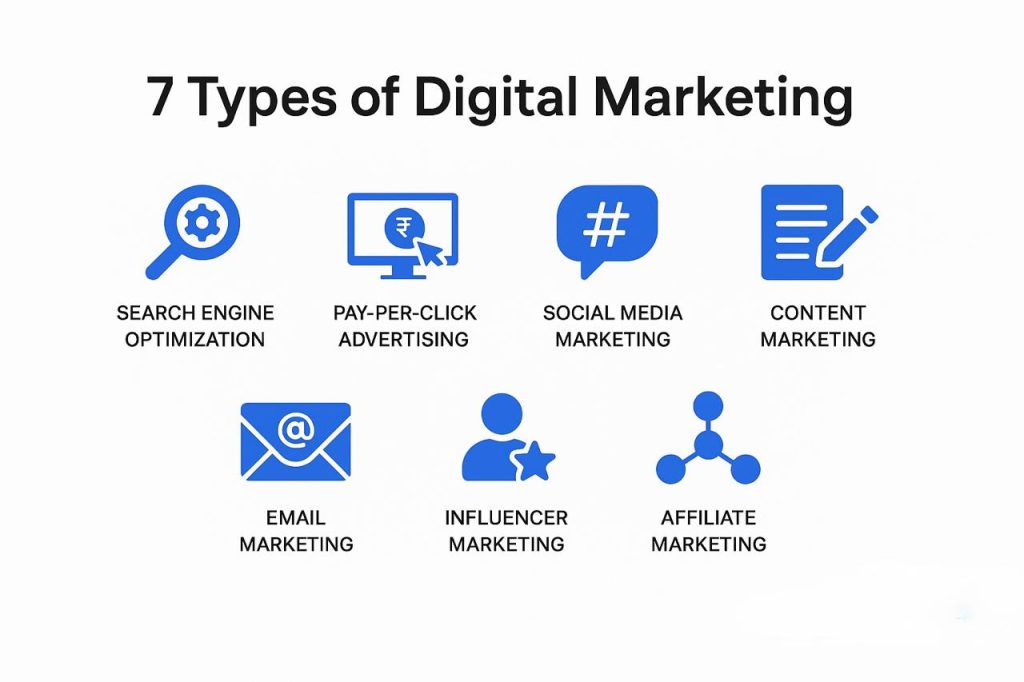
Digital marketing simply means promoting products or services using online platforms, digital devices, and internet-based tools. It allows businesses to reach specific audiences, measure performance instantly, and improve strategies based on real-time data. There are many forms of digital marketing, but seven major types are widely recognized and used across industries.
Let us understand each of them in detail.
1. Search Engine Optimization (SEO)
Search Engine Optimization, commonly known as SEO, is the process of improving a website so that it ranks higher on search engines like Google.
Whenever people search for something online, they usually click on one of the first few results they see. SEO helps a website appear among those top results without paying for advertisements. It focuses on using the right keywords, creating quality content, improving website speed, and building credibility through backlinks.
SEO can be divided into three main parts:
- On-page SEO (optimizing content and keywords on the website)
- Off-page SEO (building links and authority from other websites)
- Technical SEO (improving website structure and performance)
Although SEO takes time to show results, it is a long-term strategy that builds trust and generates consistent organic traffic.
2. Pay-Per-Click Advertising (PPC)
Pay-Per-Click (PPC) is a paid marketing method where businesses pay a fee each time someone clicks on their advertisement. Unlike SEO, PPC gives immediate visibility.
One of the most commonly used platforms for PPC advertising is Google Ads. Through this platform, businesses can bid on keywords so that their ads appear at the top of search results.
The main advantages of PPC include:
- Instant traffic
- Targeted audience selection
- Flexible budget control
- Measurable results
However, PPC campaigns require proper planning and monitoring. If not managed correctly, businesses may spend money without achieving desired results.
3. Social Media Marketing (SMM)
Social Media Marketing involves promoting products and services through social media platforms. Today, millions of people use platforms such as Facebook, Instagram, LinkedIn, and Twitter on a daily basis.
Businesses use these platforms to:
- Share posts and updates
- Run paid advertisements
- Interact directly with customers
- Build brand awareness
Social media marketing helps brands connect with their audience on a more personal level. It also allows companies to track engagement through likes, comments, shares, and reach.
4. Content Marketing
Content marketing focuses on creating valuable and relevant content to attract and retain customers. Instead of directly promoting products, businesses provide useful information that solves problems or answers questions.
Examples of content marketing include:
- Blog articles
- Videos
- Infographics
- E-books
- Podcasts
For instance, many brands use YouTube to share educational and promotional videos.
The goal of content marketing is to build trust and establish authority in a particular industry. When customers trust a brand, they are more likely to make purchases from it.
5. Email Marketing
Email marketing is one of the oldest forms of digital marketing, yet it remains highly effective. It involves sending emails to customers and subscribers to inform them about new products, offers, or updates.
Businesses collect email addresses through website sign-ups, online purchases, or newsletters. They then send:
- Promotional offers
- Product announcements
- Newsletters
- Personalized recommendations
Email marketing is cost-effective and provides a high return on investment when used correctly. The key to success is sending relevant and valuable content instead of spam.
6. Affiliate Marketing
Affiliate marketing is a performance-based strategy where businesses reward individuals or partners for generating sales through their promotion.
Affiliates promote products on their websites, blogs, or social media accounts and earn a commission for each successful sale. A popular example is the affiliate program offered by Amazon.
This type of marketing benefits both parties. Businesses increase their sales without paying upfront advertising costs, and affiliates earn income based on performance.
7. Influencer Marketing
Influencer marketing involves collaborating with individuals who have a strong online following. These influencers promote products or services to their audience through posts, videos, or reviews.
Platforms such as Instagram and YouTube are commonly used for influencer campaigns.
Unlike traditional celebrity advertising, influencer marketing feels more authentic. Followers often trust influencers because they regularly share personal experiences and honest opinions. When brands choose the right influencer, it can significantly increase brand awareness and customer engagement.
Conclusion
Digital marketing has completely changed how businesses communicate with customers. The seven major types — SEO, PPC, Social Media Marketing, Content Marketing, Email Marketing, Affiliate Marketing, and Influencer Marketing — each play a unique role in building online presence and driving growth.
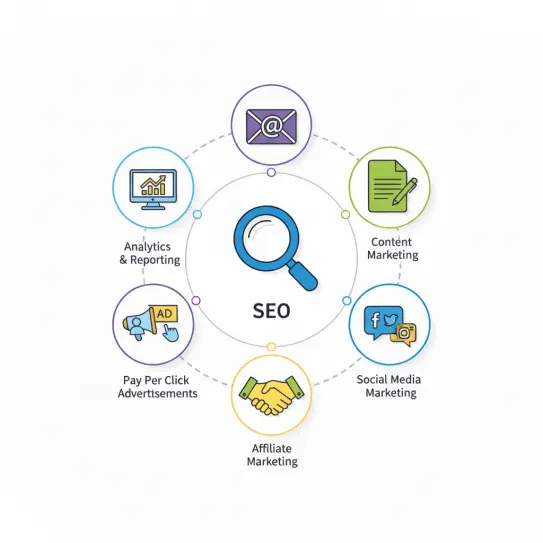
In reality, successful businesses do not rely on just one type. They combine multiple strategies to create an effective digital marketing plan. For example, a company may use SEO for long-term growth, PPC for quick results, content marketing to build trust, and social media to maintain engagement.
Understanding these seven types is essential for anyone who wants to build a career in marketing or grow a business in the digital age. As technology continues to evolve, digital marketing will remain a powerful and necessary tool for success.